

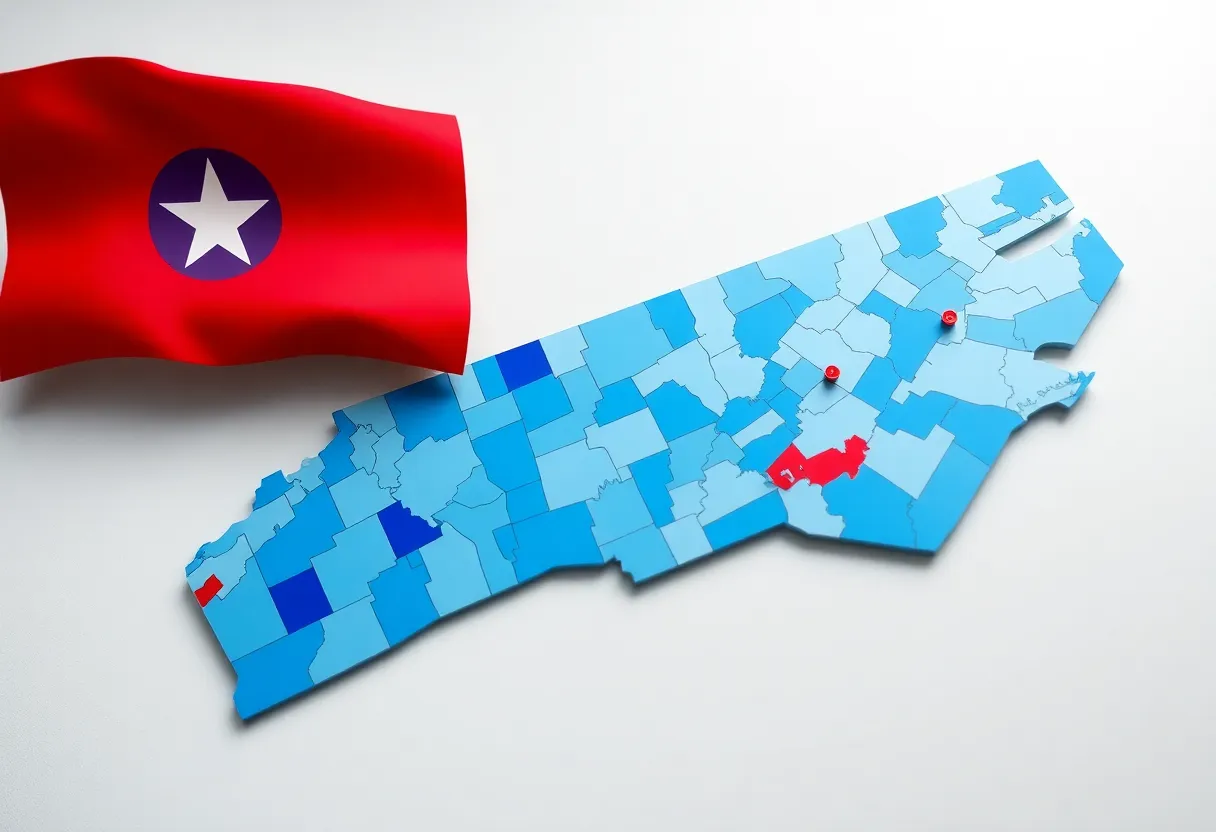
North Carolina, February 3, 2026
North Carolina is experiencing significant population growth, which may allow it to gain an additional congressional seat after the 2030 Census. With a current population of 11.2 million and projections reaching 11.7 million by 2030, the state’s rapid growth could reshape its political landscape. Discussions are underway regarding a potential 12-3 partisan split within the U.S. House delegation, amplifying North Carolina’s influence in national legislative matters.
Charlotte
North Carolina’s robust population growth, placing it among the fastest-growing states in the nation, is fueling discussions about the potential for the state to gain an additional congressional seat after the 2030 Census, possibly leading to a 12-3 partisan split in its U.S. House delegation. The latest state population estimates released this week by the U.S. Census Bureau indicate significant demographic shifts that could reshape the state’s political landscape in the coming decade.
North Carolina’s Rapid Growth and Future Representation
As of July 1, 2025, North Carolina’s population reached 11.2 million people, marking a 1.3% increase since the 2020 Census, half a decade prior. This growth rate positions North Carolina as the third-fastest growing state nationally, trailing only South Carolina and Idaho. State demographers indicate that this expansion is primarily driven by people moving into North Carolina from other U.S. states, attributed to the state’s competitive economic appeal and other factors. Projections suggest that North Carolina is on track to reach 11.7 million residents by 2030, a demographic milestone that could see it surpass Georgia and Ohio to become the seventh largest state in the nation. This sustained population increase is a critical factor in the decennial process of congressional reapportionment, where states gain or lose seats in the U.S. House of Representatives based on their population changes relative to other states.
The Apportionment Process and Its Impact
The allocation of the 435 seats in the U.S. House of Representatives among the 50 states is determined by the decennial census, a process known as apportionment. Each state is constitutionally guaranteed a minimum of one seat, with additional seats distributed using the method of equal proportions. Should North Carolina’s population trends continue as projected, the state is expected to gain an additional congressional seat following the 2030 Census. This would increase North Carolina’s total number of House representatives, further elevating its voice in national legislative matters.
Redrawing the Lines: The Redistricting Landscape
Following the release of decennial census data, typically by April 1 of the year after the census, states undertake the redistricting process to redraw their congressional and state legislative district lines. For the 2030 Census, the detailed redistricting data is anticipated to be released by April 1, 2031. In North Carolina, the state legislature is responsible for drawing these district boundaries. The process can be highly impactful, as seen in recent years; North Carolina has redrawn its congressional districts multiple times, including adjustments made after the 2020 Census due to court orders. Notably, the Governor of North Carolina does not have the power to veto redistricting maps.
The current congressional map for North Carolina, adopted in 2023, is structured to provide a significant advantage to one political party, with projections for the 2026 elections indicating a 10-4 or potentially 11-3 partisan split in favor of Republicans (10 or 11 Republicans to 3 or 4 Democrats) out of the state’s 14 existing seats. Republican lawmakers have openly stated that a primary motivation behind recent redistricting efforts has been to secure additional Republican seats in the state’s congressional delegation. If North Carolina gains a 15th congressional seat after the 2030 Census and current partisan trends in redistricting continue, a 12-3 map, implying 12 seats for one major party and 3 for the other, could become a possibility. This would further solidify the state’s political leanings in its federal representation.
The ongoing population boom in North Carolina, highlighted by the latest Census Bureau estimates, sets the stage for a critical period of reapportionment and redistricting post-2030. The outcome will not only determine the state’s numerical representation in the U.S. House but also significantly influence its political direction for the subsequent decade.
Frequently Asked Questions (FAQ)
What is the current population of North Carolina according to the latest estimates?
As of July 1, 2025, North Carolina’s population reached 11.2 million people.
How fast is North Carolina’s population growing compared to other states?
North Carolina’s population grew by 1.3% to 11.2 million people as of July 1, 2025, ranking it as the third-fastest growing state nationally, behind South Carolina and Idaho.
What is driving North Carolina’s population growth?
Much of North Carolina’s population growth is driven by domestic migration due to the state’s competitive economic appeal and other factors.
Is North Carolina expected to gain more congressional seats?
North Carolina is projected to reach 11.7 million people by 2030 and is expected to gain an additional congressional seat following the 2030 Census.
What is congressional apportionment?
Congressional apportionment is the process by which seats in the U.S. House of Representatives are distributed among the 50 states according to the most recent decennial census.
How many congressional seats are there in the U.S. House of Representatives?
The U.S. House of Representatives has a maximum of 435 seats, which are capped at that number by federal law.
When will the next redistricting data be released after the 2030 Census?
The detailed 2030 redistricting data (P.L. 94-171 data) is planned for release by April 1, 2031.
Who is responsible for drawing congressional district lines in North Carolina?
In North Carolina, elected representatives in the state legislature are responsible for drawing the congressional district lines.
Can the Governor of North Carolina veto redistricting maps?
No, the Governor of North Carolina does not have the power to veto redistricting maps.
Key Features: North Carolina’s Population and Congressional Representation
| Feature | Detail | Scope |
|---|---|---|
| Current Population (July 1, 2025) | 11.2 million people | State-level |
| Population Growth Rate (July 2024 – July 2025) | 1.3% | State-level |
| National Growth Rank (July 2024 – July 2025) | 3rd fastest growing state nationally | Nationwide |
| Projected Population (by 2030) | 11.7 million people | State-level |
| Projected Congressional Seats (post-2030 Census) | Likely to gain an additional seat | State-level |
| Total U.S. House Seats | 435 seats (capped by federal law) | Nationwide |
| Apportionment Basis | Decennial Census population count | Nationwide |
| Redistricting Data Release (2030 Census) | By April 1, 2031 | Nationwide |
| Redistricting Authority (NC) | State Legislature | State-level |
| Governor’s Veto Power on Maps (NC) | None | State-level |
Deeper Dive: News & Info About This Topic
HERE Resources
Celebrating Charlotte’s Culinary Spirit: A Local Soul Food Gem
Charlotte’s Economic Pulse: Private Investment Fuels Growth
Charlotte: A Prime Destination for Homebuyers
New Tip Deduction: Boosting Charlotte’s Service Sector
Charlotte’s Economic Growth and Real Estate Dynamics
Belmont’s Historic Land Auction: A Catalyst for Development
Charlotte Braces for Winter: Community Preparedness in Action
North Carolina’s Urgent Psychiatric Bed Crisis Requires Attention
Charlotte’s Growth Engine: Boosting Local Business Visibility
Mecklenburg County Faces Uncertainty Over Federal Housing Funding

Author: HERE Charlotte
The CHARLOTTE STAFF WRITER represents the experienced team at HERECharlotte.com, your go-to source for actionable local news and information in Charlotte, Mecklenburg County, and beyond. Specializing in "news you can use," we cover essential topics like product reviews for personal and business needs, local business directories, politics, real estate trends, neighborhood insights, and state news affecting the area—with deep expertise drawn from years of dedicated reporting and strong community input, including local press releases and business updates. We deliver top reporting on high-value events such as Lovin' Life Music Festival, Charlotte Pride festival, and major sporting tournaments at Bank of America Stadium. Our coverage extends to key organizations like the Charlotte Regional Business Alliance and Foundation for the Carolinas, plus leading businesses in finance and entertainment that power the local economy such as Bank of America and NASCAR. As part of the broader HERE network, including HEREAsheville.com, HEREGreensboro.com, HERERaleigh.com, and HEREOBX.com, we provide comprehensive, credible insights into North Carolina's dynamic landscape.