

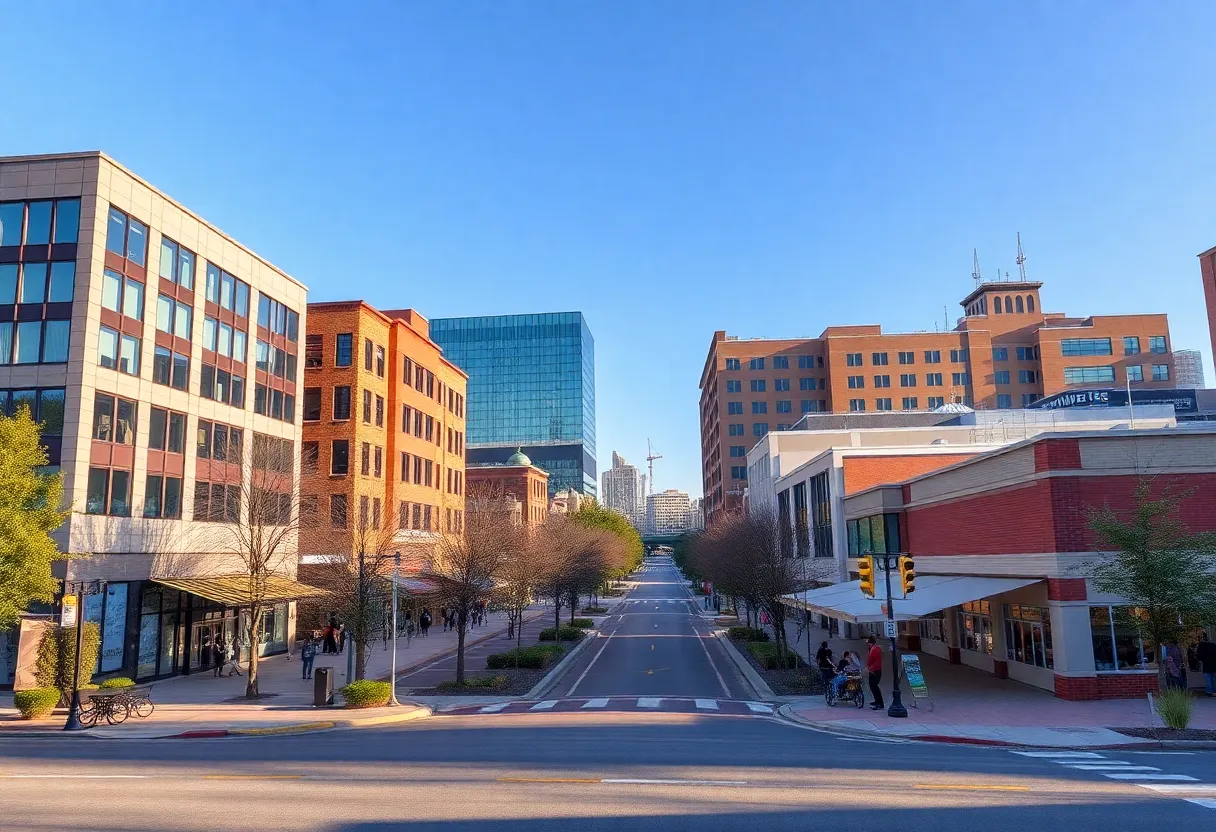
Columbia, SC, January 3, 2026
Columbia, SC, is experiencing a transformative economic renaissance characterized by growth in various sectors, including technology and retail. The Midlands region is focusing on fostering entrepreneurial innovation, strategic investments, and community engagement to reshape its economic future. Notably, Columbia secured a significant federal grant to enhance its tech sector, reflecting a proactive approach in driving sustainable economic development. As the local business community continues to thrive, Columbia aims to diversify its economy and capitalize on the broader momentum of the Carolinas.
Columbia’s Economic Renaissance: Forging a Path to Prosperity
As the Carolinas experience dynamic growth, Columbia, SC, actively cultivates entrepreneurial innovation and strategic investments, reshaping its economic future.
The economic landscape across the Carolinas is vibrant, with many cities demonstrating robust expansion and attracting significant investment. While neighboring metropolitan areas like Charlotte, North Carolina, garnered attention in 2025 for successfully attracting diverse international companies spanning the automotive, energy, aviation, and medical technology sectors, Columbia, SC, has been diligently laying its own groundwork for substantial economic advancement. This regional momentum serves as a powerful reminder of the potential for growth when local entrepreneurs are empowered, smart policies are implemented, and community engagement remains a priority. The Midlands region, including Columbia, has been increasingly focused on fostering an environment that encourages business resilience and innovation, crucial elements for a thriving local economy.
Columbia’s progress is a testament to the determination of its local business community and the strategic foresight of its leadership. By emphasizing initiatives that reduce barriers to entry and accelerate business growth, the city aims to carve out its unique position within this dynamic regional economy. The focus on verifiable facts and balanced perspectives allows us to appreciate not only the achievements but also the ongoing efforts to ensure a prosperous future for all residents and businesses in the Capital City.
Regional Economic Vibrancy and South Carolina’s Competitive Edge
The broader Carolinas region has emerged as a significant economic powerhouse, attracting global attention and investment. Charlotte, North Carolina, experienced its best year for business recruitment in a decade in 2025, marking a period of robust economic growth. This success included welcoming international companies across key sectors such as automotive, energy, aviation, and medical technology. Such achievements highlight the effectiveness of proactive economic development strategies and a conducive business environment.
South Carolina, too, has demonstrated its strong competitive position. In 2025, the state was recognized as the 2nd in the Top States for Business by Area Development magazine and ranked 18th overall by CNBC. This recognition underscores South Carolina’s appealing business climate, which includes strong performance in business incentive programs, overall cost of doing business, and site readiness programs, where it secured the top spot according to Area Development in 2025. Additionally, the state ranked 2nd in the availability of sites, cooperative local and state government, and a favorable regulatory framework. These factors, combined with a low corporate tax rate of 5%, no state-levied property taxes, local income taxes, or inventory taxes, and the lowest unionization rate in the country at 2.3%, create a compelling case for investment. The state’s commitment to attracting international firms is evident through various initiatives developed by state and local governments. In March 2025 alone, four companies announced plans to open or expand operations in South Carolina, representing a $123 million investment and creating 214 new jobs. Furthermore, in 2025, South Carolina secured major reinvestments and supplier expansions, notably from European and Asian firms, including Rolls-Royce in Aiken County, Eurocharm Group from Taiwan, SCHNEEBERGER from Switzerland, and CS Instruments from Germany.
Columbia’s Emerging Tech Hub and Entrepreneurial Surge
Columbia, SC, is actively cultivating its own distinct identity as an emerging hub for technology and innovation. In 2025, the city was poised for a significant transformation, with its startup ecosystem projected for a 25% growth. This momentum is fueled by strategic investments in advanced technologies like artificial intelligence (AI), cyber labs, and battery innovation. A notable achievement in 2025 was Columbia securing a substantial $45 million federal grant for SC NEXUS, positioning it as one of only twelve tech hubs Nationwide to receive such funding.
The city’s entrepreneurial spirit is evident in the rise of promising startups. Companies like Vän Robotics, specializing in education technology, and Scout Motors, focusing on electric vehicles, are leading innovations and were anticipated to contribute to an economic impact of $1.2 billion by 2024. Columbia’s supportive environment for new ventures is bolstered by various resources, initiatives, and collaborative spaces. Institutions such as the USC/Columbia Technology Incubator and the Benedict College Business Development Center provide essential space, training, and resources for early-stage technology and innovation-based companies, as well as minority entrepreneurs. These efforts underscore a strategic push to diversify the Richland County economy beyond its historical reliance on state government and the University of South Carolina.
Strategic Development and Public-Private Partnerships
Recognizing the importance of collaborative efforts in driving economic prosperity, Richland County embarked on a significant strategic shift in 2025. The county launched a public-private partnership (P3) with the aim of boosting jobs and fostering tech growth, actively working to attract businesses and secure quality employment opportunities for residents. This initiative officially began its operations in July 2025.
A key component of this strategy is the Columbia Area Development Partnership (CADP), which launched in May 2025. This new collaboration serves as the exclusive local organization dedicated to leading Richland County’s economic development, fostering innovation, and accelerating job creation. The CADP’s mission is to build lasting partnerships and effectively position Richland County as a competitive destination for industry investments and high-quality jobs. Furthermore, Richland County has been actively engaging its residents and businesses in shaping its future through the “Reimagine Richland” comprehensive plan for 2025, which provides a long-term guide for development policies and community investment. To support business expansion, Richland County offers a comprehensive “toolbox of incentives,” which includes abatements, financing options, tax credits, and utility rebates. Such proactive measures reflect a commitment to creating an environment where businesses can thrive and contribute to overall Midlands economic growth.
Diversifying the Richland County Economy
Columbia, SC, experienced dynamic economic growth in 2025, notably highlighted by a thriving retail sector and the arrival of prominent retailers, indicating increased consumer demand and effective local policies. This expansion is part of a broader diversification of the Richland County economy, moving beyond its traditional pillars of state government and the University of South Carolina. The influx of large retail chains not only enhances the local market but also creates significant opportunities for Columbia small business owners, reinforcing the region’s economic vitality.
The city’s evolving landscape was evident with numerous new businesses and retail establishments opening across the Midlands in 2025, including a diverse range of restaurants, big box stores, supermarkets, and boutiques. A particularly exciting development was the official opening of Gather COLA, Columbia’s first open-air food hall, in the BullStreet District in December 2025. Additionally, The Laundry, a new event venue, began operations in the BullStreet District in April 2025. These developments showcase a dynamic shift in Columbia’s lifestyle, with new rooftop bars, high-end hotels, and waterfront dining emerging. The region is also experiencing significant population growth, a trend observed across the Carolinas, with the Charlotte Region, for example, attracting 157 people daily. This demographic shift is mirrored in Columbia, with thousands moving to the area annually, prompting national developers to introduce luxury townhomes and amenity-rich neighborhoods. Even with this growth, home prices in Columbia remained more affordable than in Charlotte in 2025.
Workforce Development and Favorable Business Climate
A robust workforce is a cornerstone of economic success, and South Carolina has prioritized initiatives to ensure a skilled talent pipeline. In 2025, workforce recruitment, training, and retention of qualified employees were identified as key issues impacting businesses across the state. In response, South Carolina continues to provide funding for technical college scholarships for high-demand jobs and other workforce development initiatives. For instance, in Richland and Crawford Counties, $186,000 in state funding was utilized to upskill local employees, demonstrating an investment in strengthening the workforce. The state aims to bridge the gap between educational institutions and the business community, ensuring students are equipped with the foundational skills demanded by employers in the Palmetto State.
Beyond workforce initiatives, South Carolina maintains a business-friendly environment designed to attract and retain companies. The state boasts a low corporate tax rate of 5%, and notably, no state-levied property taxes, local income taxes, or inventory taxes. Furthermore, South Carolina operates as a right-to-work state and has the lowest unionization rate in the country at 2.3%. The 2025 Competitiveness Agenda by the South Carolina Chamber of Commerce outlines priorities to further reduce business tax burdens, modernize the tax code, and address workforce shortages, all aimed at enhancing the state’s economic appeal. The observed impact of policy decisions, such as an immigration crackdown affecting businesses in Charlotte in 2025, serves as a reminder for Columbia, SC, about the critical need for a diverse and adequate labor force to sustain Midlands economic growth and support job creation.
Conclusion
Columbia, SC, is in the midst of an exciting economic transformation, actively shaping its future through strategic development, entrepreneurial innovation, and a commitment to a business-friendly environment. From the launch of the Columbia Area Development Partnership to its emergence as a tech destination with significant federal funding and a burgeoning startup ecosystem, the city is demonstrating a proactive approach to fostering sustainable Midlands economic growth. The diversification of the Richland County economy, highlighted by a dynamic retail sector and a growing population, signals a vibrant and resilient future for Columbia SC business.
As South Carolina entrepreneurs continue to innovate and local leadership implements policies that support expansion and job creation, Columbia is well-positioned to capitalize on the broader regional economic momentum. We encourage all residents to support Columbia small business, engage with community initiatives, and stay informed about the ongoing efforts that are defining our city’s prosperity.
Frequently Asked Questions
Q: What was Columbia, SC’s economic growth like in 2025?
A: Columbia, SC, experienced dynamic economic growth in 2025, highlighted by a thriving retail sector and the arrival of prominent retailers, indicating increased consumer demand and effective local policies.
Q: What initiatives did Richland County launch in 2025 to boost economic growth?
A: Richland County launched a public-private partnership (P3) in 2025 to boost jobs and tech growth, aiming to attract businesses and secure quality job opportunities. The Columbia Area Development Partnership (CADP) also launched in May 2025 as the exclusive local organization to lead Richland County’s economic development.
Q: How did South Carolina rank for business in 2025?
A: South Carolina ranked 2nd in 2025 in the Top States for Business by Area Development magazine and 18th overall by CNBC.
Q: What were some key features of South Carolina’s business climate in 2025?
A: In 2025, South Carolina ranked #1 for business incentive programs, overall cost of doing business, and site readiness programs by Area Development. It also ranked #2 in availability of sites; cooperative local and state government; and favorable regulatory framework. The state has a low corporate tax rate of 5%, no state-levied property taxes, local income taxes, or inventory taxes, and the lowest unionization rate in the country at 2.3%.
Q: Did Columbia, SC, see growth in its tech and startup sector in 2025?
A: Yes, Columbia, SC, was emerging as a tech destination in 2025, with its startup ecosystem poised for a 25% growth, fueled by federal funding and projects like the BullStreet District transformation. Investments were made in advanced technologies such as AI, cyber labs, and battery innovation.
Q: What kinds of new businesses opened in Columbia, SC, in 2025?
A: New businesses and retail establishments opened across the Midlands in 2025, including a diverse range of restaurants, big box stores, supermarkets, and boutiques. Gather COLA, Columbia’s first open-air food hall, opened in the BullStreet District in December 2025, and The Laundry, a new event venue, opened in April 2025 in the same district.
Key Features of Columbia, SC’s Economic Growth in 2025
| Feature | Detail | Scope |
|---|---|---|
| Overall Economic Growth | Experienced dynamic economic growth, highlighted by retail expansion and increased consumer demand. | Local (Columbia, SC) |
| Richland County Partnerships | Launched a public-private partnership (P3) to boost jobs and tech growth, attracting businesses and securing quality job opportunities. | Local (Richland County) |
| Tech Sector & Startups | Emerging as a tech destination with a 25% projected growth in its startup ecosystem. Federal funding, including a $45 million grant for SC NEXUS, and investments in AI, cyber labs, and battery innovation. | Local (Columbia, SC), Nationwide (SC NEXUS grant) |
| Retail & Lifestyle Expansion | Diverse range of new restaurants, big box stores, supermarkets, and boutiques opened. Columbia’s first open-air food hall, Gather COLA, and a new event venue, The Laundry, opened in the BullStreet District. | Local (Columbia, SC) |
| Workforce Development | $186,000 in state funding used to upskill local employees in Richland and Crawford Counties. South Carolina provided funding for technical college scholarships for high-demand jobs and other workforce development initiatives. | Local (Richland & Crawford Counties), State-level (South Carolina) |
| Business Climate (State-level) | Ranked 2nd in Top States for Business by Area Development and 18th by CNBC. Ranked #1 for business incentives, cost of doing business, and site readiness programs. Low corporate tax rate (5%), no state-levied property, local income, or inventory taxes. Lowest unionization rate (2.3%). | State-level (South Carolina) |
| International Investment (State-level) | Secured major reinvestments and supplier expansions from European and Asian firms, including Rolls-Royce (Aiken County), Eurocharm Group (Taiwan), SCHNEEBERGER (Switzerland), and CS Instruments (Germany). | State-level (South Carolina) |
Deeper Dive: News & Info About This Topic
HERE Resources
Regional Transportation Firm’s Sudden Closure Highlights Economic Realities
North Carolina’s $40 Million Land Campaign: Lessons for Columbia SC
Entrepreneurship Drives Columbia, SC’s Economic Future
South Carolina Developers Drive Regional Prosperity
Wake Forest and Mississippi State Universities Enhance Community Engagement
Charlotte Welcomes New Year with Celebrations and New Laws
Reflecting on the Carolinas’ Most Significant Stories
Financial Leadership and Economic Growth in Columbia, SC
Maersk Chooses Charlotte for North American Headquarters
Atrium Health’s Strategic Expansion Enhances Healthcare Access

Author: HERE Charlotte
The CHARLOTTE STAFF WRITER represents the experienced team at HERECharlotte.com, your go-to source for actionable local news and information in Charlotte, Mecklenburg County, and beyond. Specializing in "news you can use," we cover essential topics like product reviews for personal and business needs, local business directories, politics, real estate trends, neighborhood insights, and state news affecting the area—with deep expertise drawn from years of dedicated reporting and strong community input, including local press releases and business updates. We deliver top reporting on high-value events such as Lovin' Life Music Festival, Charlotte Pride festival, and major sporting tournaments at Bank of America Stadium. Our coverage extends to key organizations like the Charlotte Regional Business Alliance and Foundation for the Carolinas, plus leading businesses in finance and entertainment that power the local economy such as Bank of America and NASCAR. As part of the broader HERE network, including HEREAsheville.com, HEREGreensboro.com, HERERaleigh.com, and HEREOBX.com, we provide comprehensive, credible insights into North Carolina's dynamic landscape.