

Minneapolis, January 13, 2026
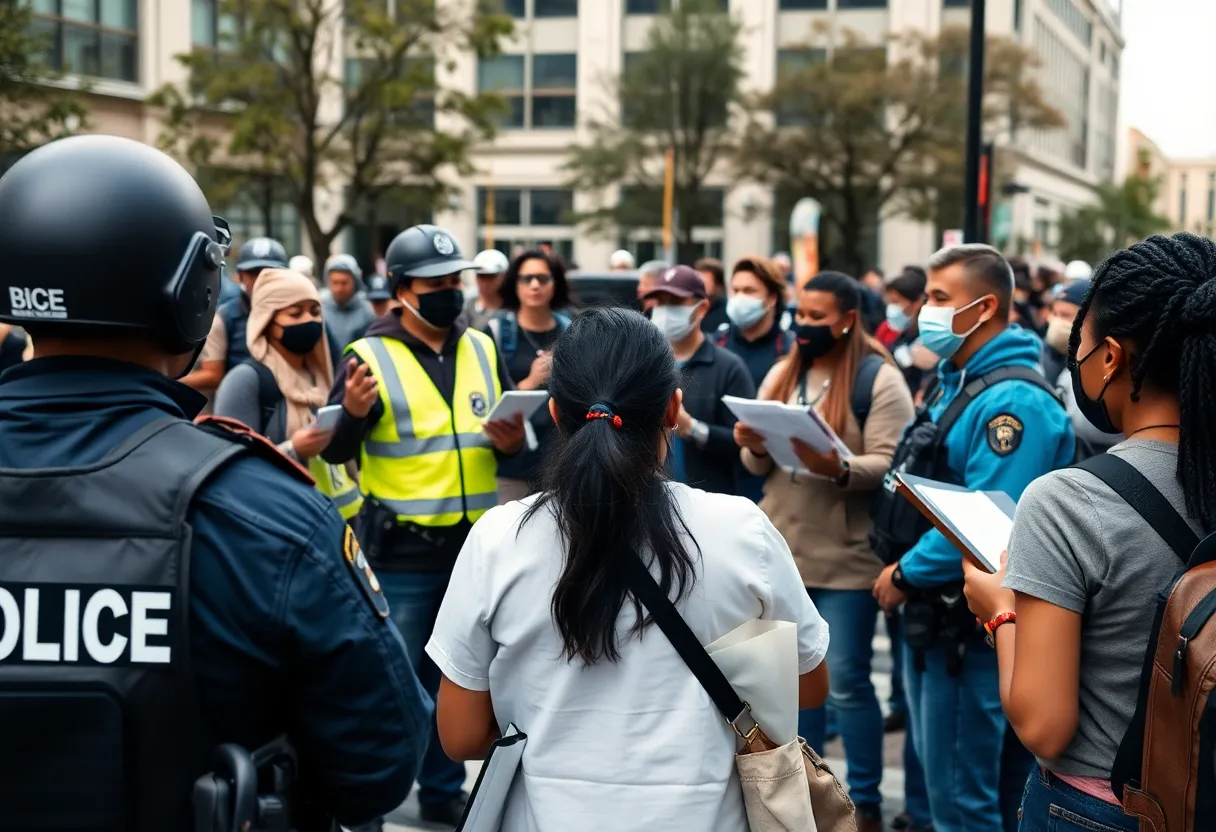
Civil liberties groups monitoring Immigration and Customs Enforcement (ICE) arrests are facing accusations from federal authorities of potentially breaking the law, as incidents of excessive force raise concerns. The tension follows the fatal shooting of activist Renée Good by an ICE officer. Activist networks are increasingly organized in documenting ICE activities to ensure community awareness and accountability, while federal responses include legal challenges regarding the monitoring efforts and heightened surveillance practices during the enforcement surge.
Nationwide: Federal Authorities Clash with Civil Liberties Groups Over ICE Arrest Monitoring Amidst Enforcement Surge
A nationwide network of activist groups monitoring Immigration and Customs Enforcement (ICE) arrests is increasingly facing accusations from federal authorities of breaking the law, potentially leading to obstruction of justice charges. This escalated tension comes as the Trump administration continues to deploy thousands of federal immigration officers across the country, prompting legal challenges from states like Minnesota and Illinois and raising concerns about civil liberties and surveillance. The intensified scrutiny of monitoring efforts follows the fatal shooting of Renée Good by an ICE officer in Minneapolis last week.
Growing Civilian Monitoring of Immigration Enforcement
A loose-knit yet increasingly organized network of activists across the United States is actively tracking the movements of federal immigration officers and documenting arrests. These volunteer efforts involve individuals blowing whistles to alert community members, following immigration enforcement vehicles at a distance, and recording agent activities in public spaces. The groups believe that documenting these actions reduces the likelihood of authorities using excessive force and provides a crucial public service by informing communities about federal immigration presence. Federal court rulings affirm that citizens possess First Amendment rights to observe and record police activity in public areas, and many monitors adhere strictly to these guidelines.
Federal Pushback and Legal Interpretations
Federal authorities, including officials from the Department of Homeland Security (DHS), contend that certain monitoring behaviors overstep legal boundaries. They argue that actions such as blocking roadways, impeding enforcement vehicles, or physically interfering with an operation could lead to charges of obstruction of justice. DHS spokeswoman Tricia McLaughlin has also stated that recording and posting images of officers online could be considered “doxing,” citing a perceived increase in threats against agents. In Charlotte, at least three individuals involved in protesting or monitoring officers have faced charges for allegedly impeding law enforcement operations. However, legal experts note that while physical obstruction is unlawful, merely annoying or passively monitoring officers is protected as a form of protest and free speech. Some former federal prosecutors suggest that while a prosecutor might theoretically build a case for interference, such prosecutions would be unusual given the constitutional protections for protest.
Fatal Shooting Ignites Widespread Protests and Scrutiny
The debate over monitoring immigration enforcement gained significant national attention following the fatal shooting of Renée Good by an ICE officer in Minneapolis last week. Good was reportedly participating in a “neighborhood patrol” tracking ICE activities when the incident occurred. While federal officials claim the officer acted in self-defense, alleging Good was “impeding” and “stalking” agents and attempted to ram her car into an officer, Minneapolis Mayor Jacob Frey and civil liberties advocates point to bystander video that they say contradicts the federal narrative. This incident has spurred nationwide anti-ICE protests and rallies demanding accountability for Good’s death.
States Challenge Federal Immigration Surge
The intensified monitoring efforts are unfolding amidst a significant escalation in federal immigration enforcement. The Trump administration has deployed thousands of federal immigration officers and agents across the nation, resulting in thousands of arrests. In December 2025, DHS initiated “Operation Metro Surge” in Minnesota’s Twin Cities, deploying thousands of armed and masked agents from ICE and Customs and Border Protection (CBP) to conduct raids and arrests. Similarly, “Operation Midway Blitz” in Illinois last year led to over 4,300 arrests.
On January 12, 2026, the State of Minnesota, along with the cities of Minneapolis and St. Paul, filed a federal lawsuit against the Department of Homeland Security (DHS). The lawsuit seeks to halt “Operation Metro Surge,” alleging that the federal deployment is unconstitutional and unlawful, involves excessive force, and targets individuals in sensitive locations such as schools, medical facilities, places of worship, daycares, and funeral homes. Illinois filed a similar lawsuit, asserting that the federal crackdown created a “chilling effect” and made residents fearful. Minnesota Attorney General Keith Ellison described the surge as a “federal invasion” of the Twin Cities.
Broader Concerns: Surveillance and the “Deportation-Industrial Complex”
The expansion of federal immigration enforcement has also ignited concerns about surveillance and data collection. DHS is facing opposition over a proposed rule to dramatically expand biometric data collection across the U.S. immigration system, which critics warn could create an “unprecedented surveillance architecture.” ICE has also acquired advanced surveillance tools, “Tangles” and “Webloc,” reportedly used to track cell phone activity, monitor social media, and identify both individuals and protesters. These tools allow for sentiment analysis of online posts and can add individuals to watchlists, raising significant human rights and privacy concerns.
Furthermore, the Trump administration’s immigration policies are seen by some as creating a “deportation-industrial complex.” This system involves government agencies, private contractors, and financial interests that profit from mass detentions and deportations, driving an expansion of detention facilities and a goal to deport one million immigrants annually. Critics argue this system prioritizes profit over due process and individual liberties. In a related development, a broad coalition of faith leaders and civil liberties organizations are challenging a Trump-Vance administration policy that allows ICE agents broad discretion to conduct enforcement actions at or near houses of worship, overturning decades of protection for such “sensitive locations.”
Frequently Asked Questions
- What is the main conflict concerning ICE arrests?
- A nationwide network of activist groups monitoring Immigration and Customs Enforcement (ICE) arrests is increasingly facing accusations from federal authorities of breaking the law, potentially leading to obstruction of justice charges.
- What prompted the increased scrutiny on monitoring ICE activities?
- The intensified scrutiny of monitoring efforts follows the fatal shooting of Renée Good by an ICE officer in Minneapolis last week.
- What actions do civilian monitoring groups take?
- These groups track the whereabouts of federal immigration officers, document arrests, blow whistles to warn community members, and sometimes follow immigration enforcement vehicles or record activities.
- What is the federal government’s stance on these monitoring activities?
- Federal authorities claim some monitoring actions, particularly those involving physical obstruction or impeding operations, could lead to obstruction of justice charges. The Department of Homeland Security also considers recording and posting images of officers online as “doxing.”
- Are there legal protections for monitoring law enforcement?
- Yes, federal court rulings state that citizens can observe and record police activity in public areas as part of their First Amendment rights.
- What legal action have states taken regarding federal immigration enforcement?
- The State of Minnesota, along with the cities of Minneapolis and St. Paul, filed a federal lawsuit against the Department of Homeland Security (DHS) to halt “Operation Metro Surge.” Illinois has filed a similar lawsuit.
- What are “Operation Metro Surge” and “Operation Midway Blitz”?
- “Operation Metro Surge” is a federal immigration enforcement operation initiated in Minnesota’s Twin Cities in December 2025. “Operation Midway Blitz” was a similar operation in Illinois. Both involve the deployment of thousands of armed and masked DHS agents.
- What are the concerns regarding federal surveillance tools?
- Civil liberties groups are concerned about DHS’s proposed rule to expand biometric data collection and ICE’s use of tools like “Tangles” and “Webloc” to track phone activity, monitor social media, and identify individuals and protesters, which they warn could create an “unprecedented surveillance architecture.”
Key Features of the Nationwide ICE Enforcement and Monitoring Dispute
| Feature | Description | Geographic Scope |
|---|---|---|
| Civilian Monitoring | Activists track and record ICE activities, warn communities, and document arrests. | Nationwide |
| Federal Accusations | Federal authorities allege some monitoring constitutes obstruction of justice or “doxing.” | Nationwide |
| Legal Protections | First Amendment protects recording law enforcement in public; physical obstruction is illegal. | Nationwide |
| Renée Good Shooting | Fatal shooting of an activist by an ICE officer in Minneapolis intensified scrutiny. | Minneapolis (State-level impact, Nationwide attention) |
| Federal Enforcement Surges | Deployment of thousands of federal immigration officers for operations like “Metro Surge” and “Midway Blitz.” | Minnesota, Illinois (State-level operations, Nationwide strategy) |
| State Lawsuits | Minnesota and Illinois filed federal lawsuits against DHS to halt enforcement surges. | Minnesota, Illinois (State-level legal action) |
| Surveillance Tools | ICE utilizes tools like “Tangles” and “Webloc” for phone and social media tracking. | Nationwide |
| Biometric Data Expansion | DHS proposed rule to expand biometric data collection across the U.S. immigration system. | Nationwide |
| “Deportation-Industrial Complex” | Concept describing a system where government and private entities profit from mass detentions and deportations. | Nationwide |
Deeper Dive: News & Info About This Topic
HERE Resources
Tragic Motorcycle Accident Claims Life in North Charlotte
California NFL Teams Make Wild Card Weekend History
Navigating Winter Challenges in Charlotte
Charlotte’s Mixed Results in Road Safety Efforts
Carolinas Prepare for Weekend Weather Shift: Warm to Cold
Learning from Charlotte: Improving Transit Safety in Columbia
Charlotte Thwarts Alleged New Year’s Eve Terror Plot
Building Trust: Why Price Accuracy Fuels Columbia SC’s Economy
FBI Halts Terror Plot in North Carolina
Port Charlotte Man Arrested for Attempting to Seduce Child Online

Author: HERE Charlotte
The CHARLOTTE STAFF WRITER represents the experienced team at HERECharlotte.com, your go-to source for actionable local news and information in Charlotte, Mecklenburg County, and beyond. Specializing in "news you can use," we cover essential topics like product reviews for personal and business needs, local business directories, politics, real estate trends, neighborhood insights, and state news affecting the area—with deep expertise drawn from years of dedicated reporting and strong community input, including local press releases and business updates. We deliver top reporting on high-value events such as Lovin' Life Music Festival, Charlotte Pride festival, and major sporting tournaments at Bank of America Stadium. Our coverage extends to key organizations like the Charlotte Regional Business Alliance and Foundation for the Carolinas, plus leading businesses in finance and entertainment that power the local economy such as Bank of America and NASCAR. As part of the broader HERE network, including HEREAsheville.com, HEREGreensboro.com, HERERaleigh.com, and HEREOBX.com, we provide comprehensive, credible insights into North Carolina's dynamic landscape.