

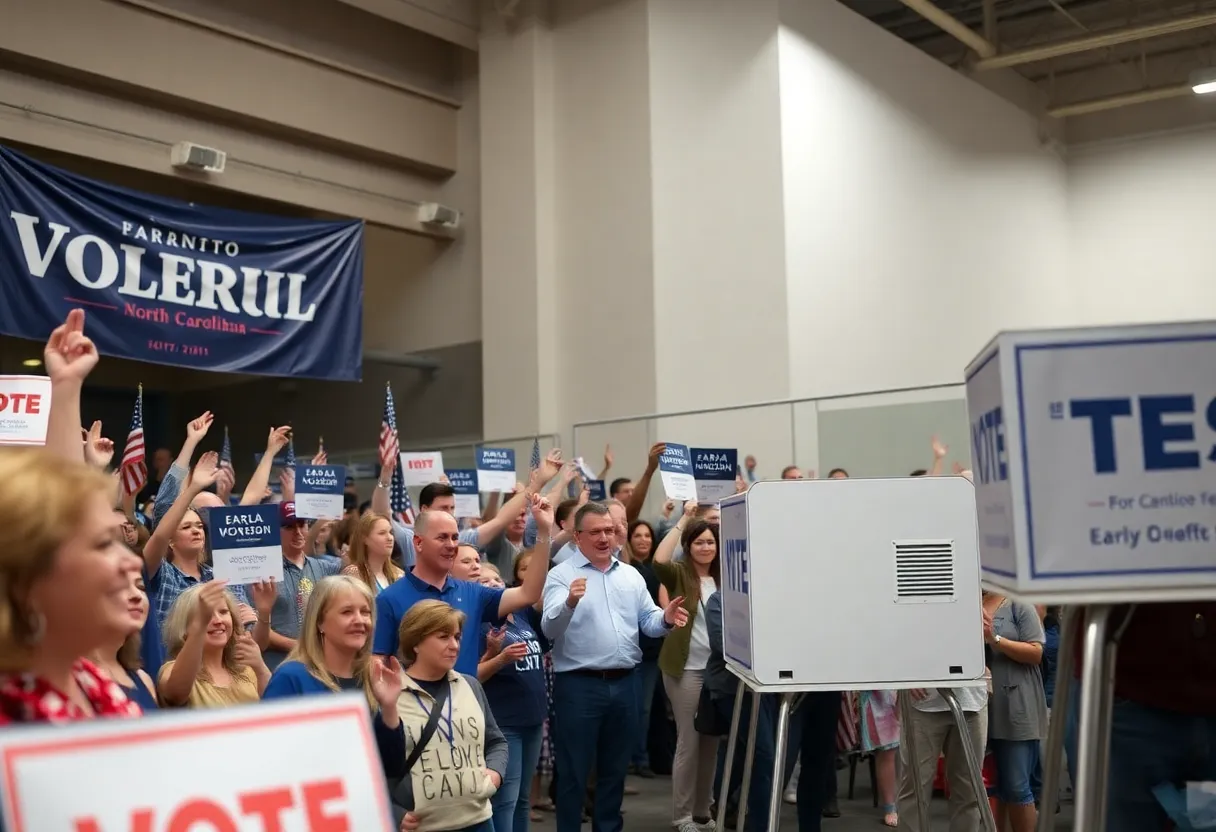
Charlotte, North Carolina, December 23, 2025
As the 2026 midterm election cycle approaches, North Carolina is witnessing a surge in political activity. The State Board of Elections has approved early voting plans, yet discussions on reducing voter access loom. Key races, including a pivotal U.S. Senate contest and all state House seats, are drawing significant candidate interest amidst intense campaign financing. Nationwide, the election landscape is also evolving as parties gear up for pivotal congressional and gubernatorial elections, with trends indicating a growing reliance on digital campaign strategies and AI technologies.
Charlotte, North Carolina – As the 2026 midterm election cycle rapidly approaches, recent developments in North Carolina and across the nation indicate an early surge in political activity, focusing on candidate filings, campaign financing, and pivotal discussions surrounding voter access. Within the last 48 hours, North Carolina’s State Board of Elections has acted on early voting plans for the upcoming elections, while candidate fields have solidified in key races, setting the stage for competitive contests at both state and federal levels.
North Carolina Election Landscape Takes Shape
In a significant development for North Carolina’s 2026 elections, the State Board of Elections recently approved a majority of early voting plans, though over a third of the state’s counties, specifically 36 of them, are considering measures that could lead to reduced voter access. These proposed changes, which include discussions around eliminating Sunday voting or college campus polling sites, have sparked debate, with some appearing politically motivated. The primaries for these elections are scheduled for March 3, 2026, followed by runoff elections on May 12, 2026, and the general election on November 3, 2026.
The field of candidates for the 2026 elections in North Carolina has now been largely set, with thousands of individuals filing for various offices. This includes contests for the U.S. House of Representatives, the U.S. Senate, state legislative seats, state courts, and numerous local positions. Many of these races will feature primary elections in March 2026 to determine each party’s nominees for the general election.
Key State-Level and Federal Races in North Carolina
The U.S. Senate race in North Carolina is drawing considerable attention and is anticipated to be one of the most expensive contests Nationwide, with some estimates suggesting spending could reach a billion dollars. Former Democratic Governor Roy Cooper and former Republican National Committee Chairman Michael Whatley are widely considered the leading contenders, despite facing primary challenges. Campaign finance reports show Governor Cooper’s campaign and associated committees have raised $14.5 million, while Mr. Whatley has accumulated $5.8 million, highlighting the financial intensity of the race even at this early stage.
At the state legislative level, all 120 seats in the North Carolina House of Representatives are up for election. Republicans currently hold 71 seats, just one short of a supermajority, while Democrats hold 49. Nine incumbent-held seats in the State House are open due to retirements or other reasons, presenting opportunities for shifts in partisan control. Democrats would need to secure an additional 12 seats to achieve a majority in the chamber.
Judicial elections are also on the ballot, including one seat on the North Carolina Supreme Court and three seats on the North Carolina Court of Appeals. Incumbent Democratic Supreme Court Justice Anita Earls is seeking re-election and is being challenged by Republican State Representative Sarah Stevens.
Furthermore, North Carolina voters will consider a significant statewide ballot measure in November 2026. Senate Bill 921, passed by the North Carolina Legislature in December 2024, proposes to amend the State Constitution to require voters to present photo identification regardless of their voting method. This measure will require approval from at least 50% of North Carolina voters to become law.
Nationwide 2026 Election Outlook Emerges
Beyond North Carolina, the political landscape for the Nationwide 2026 midterm elections is also starting to take shape. All 435 seats in the U.S. House of Representatives and 35 of the 100 seats in the U.S. Senate are up for contention on November 3, 2026. Additionally, 36 states and three territories will hold gubernatorial elections Nationwide.
U.S. Senate Races Nationwide
In the U.S. Senate, Republicans currently hold a 53-47 majority, with two independents caucusing with Democrats. Democrats face the challenge of flipping at least four seats to gain control of the chamber. The 2026 Senate map is generally seen as favorable to Republicans, though Democrats are energized by potential opportunities. Nine senators, comprising four Democrats and five Republicans, have announced their retirement and will not seek re-election in 2026. Two special elections are also scheduled for November 3, 2026, in Ohio and Florida, to fill unexpired terms.
Gubernatorial Contests Nationwide
The Cook Political Report released its 2026 Governor Race ratings on December 20, 2025, providing early assessments of competitiveness across the 36 states with gubernatorial elections Nationwide. Notable developments include an intensifying Republican primary for governor in New York, where Nassau County Executive Bruce Blakeman has challenged Congresswoman Elise Stefanik.
In Texas, Democrats have made a historic move by fielding a candidate for every state and federal race on the 2026 ballot, an unprecedented effort by either party in modern state history. This comprehensive recruitment strategy aims to maximize down-ballot victories and increase Democratic voter engagement and turnout across the state.
Evolving Campaign Strategies Nationwide
As campaigns gear up for 2026, several key trends are emerging in political strategy Nationwide. The “influencer explosion” is becoming a significant factor, with campaigns exploring partnerships with online influencers and content creators to reach specific audiences, drawing lessons from successful operations in 2025 elections. The continued integration of Artificial Intelligence (AI) in advertising is also notable, with ad makers using AI for tasks such as A/B testing scripts and creating voiceovers for ad spots. Campaign operatives are increasingly leveraging AI for automating tasks like voter targeting, modeling, and analysis, potentially making campaign services more accessible to a wider range of candidates.
The Democratic Legislative Campaign Committee (DLCC) has outlined its 2026 Target Map, identifying state legislative chambers where Democrats aim to achieve new majorities, supermajorities, and trifectas Nationwide. These “battleground states,” such as Alaska, are where control could be decided by very narrow margins, emphasizing the national strategy to bolster Democratic power in state legislatures.
The Road to 2026
With the 2026 midterms now firmly on the horizon, the early actions in North Carolina and broader Nationwide trends highlight the high stakes of these elections. From local voter access debates to high-profile federal races and evolving campaign technologies, political parties and candidates are already mobilizing to shape the outcome of the next election cycle. The coming months are expected to bring further clarity to candidate fields, campaign platforms, and the issues that will dominate the national conversation.
Frequently Asked Questions About the 2026 Elections
When are the 2026 elections scheduled to occur?
The primary elections in North Carolina are scheduled for March 3, 2026, with runoff elections on May 12, 2026. The general election, which includes federal, state, and local races Nationwide, will be held on November 3, 2026.
What are the key races in North Carolina for 2026?
Key races in North Carolina for 2026 include a U.S. Senate seat, all 14 of the state’s U.S. House of Representatives seats, all seats in the North Carolina Senate and House of Representatives, as well as judicial and local elections.
What is the latest development regarding early voting in North Carolina?
Recently, the North Carolina State Board of Elections approved most early voting plans, but 36 counties, representing over a third of the state, could potentially reduce voter access. Some proposed changes involve eliminating Sunday voting or college campus polling sites.
How many U.S. Senate seats are up for election Nationwide in 2026?
35 of the 100 seats in the U.S. Senate are up for election Nationwide on November 3, 2026, including 33 Class 2 seats and two special elections in Ohio and Florida.
What are some emerging campaign trends for the 2026 elections?
Emerging campaign trends for the 2026 elections include the “influencer explosion,” where campaigns partner with online influencers, and the continued rise of Artificial Intelligence (AI) in advertising for tasks like A/B testing and voiceovers. AI is also being used to automate voter targeting and analysis.
Key Features of the 2026 Election Cycle
| Election Level | Offices Up for Election | Current Status / Key Developments (as of Dec 21-23, 2025) | Geographic Scope |
|---|---|---|---|
| North Carolina State-Level | Governor (not up for election in 2026), State Senate (all seats), State House (all 120 seats), Judicial (Supreme Court, Court of Appeals), Ballot Measures | Early voting access changes under consideration in 36 counties. Candidate filing period closed. Republican control in State House (71-49), Democrats need 12 seats for majority. Statewide voter ID ballot measure proposed. | State-level |
| North Carolina Federal-Level | U.S. Senate (1 seat), U.S. House of Representatives (all 14 seats) | U.S. Senate race between Roy Cooper (D) and Michael Whatley (R) is anticipated to be highly competitive and expensive. Fundraising ongoing. | State-level |
| Nationwide Federal-Level | U.S. Senate (35 seats), U.S. House of Representatives (all 435 seats) | Republicans hold 53-47 Senate majority; Democrats need to flip 4 seats. 9 senators retiring. 2 special Senate elections (OH, FL). Republicans hold 219-213 House majority. | Nationwide |
| Nationwide Gubernatorial-Level | 36 State Governorships, 3 Territorial Governorships | Cook Political Report released early competitiveness ratings. Intensifying Republican primary in New York. Texas Democrats have fielded candidates for every state and federal race, a historic first for the state. | Nationwide |
| General Campaign Trends | N/A | Increased use of online influencers and Artificial Intelligence (AI) in advertising, voter targeting, and analysis. Democratic Legislative Campaign Committee (DLCC) focusing on state legislative majorities in “battleground states.” | Nationwide |
Deeper Dive: News & Info About This Topic
HERE Resources
North Carolina Comes Last in School Funding Efforts
Columbia’s Guide to Culinary Excellence for New Year’s Eve
Recent Developments in College Football Landscape
Zamindar’s Set to Transform Indian Dining in Charlotte
Columbia’s Retail Landscape Adapts to Next-Day Delivery Trends
Charlotte Roofing Contractor Arrested in Insurance Fraud Sting
New Restaurant and Patio Bar Opening Soon in Charlotte
Huntersville Developer Nears Completion of Innovative Housing Project
Acquittal of Former CMPD Officer Sparks Discussion on Accountability
Christopher Torres Sentenced for Child Abuse and Sex Offenses

Author: HERE Charlotte
The CHARLOTTE STAFF WRITER represents the experienced team at HERECharlotte.com, your go-to source for actionable local news and information in Charlotte, Mecklenburg County, and beyond. Specializing in "news you can use," we cover essential topics like product reviews for personal and business needs, local business directories, politics, real estate trends, neighborhood insights, and state news affecting the area—with deep expertise drawn from years of dedicated reporting and strong community input, including local press releases and business updates. We deliver top reporting on high-value events such as Lovin' Life Music Festival, Charlotte Pride festival, and major sporting tournaments at Bank of America Stadium. Our coverage extends to key organizations like the Charlotte Regional Business Alliance and Foundation for the Carolinas, plus leading businesses in finance and entertainment that power the local economy such as Bank of America and NASCAR. As part of the broader HERE network, including HEREAsheville.com, HEREGreensboro.com, HERERaleigh.com, and HEREOBX.com, we provide comprehensive, credible insights into North Carolina's dynamic landscape.